
Oral Health Basics: What Does “Bad Breath” Really Mean?
Let’s talk about bad breath. Not the occasional “ew” after dinner—but the kind that hangs around. From a veterinarian’s point of view, that kind of breath is often one of the first hints that something more is going on in a pet’s mouth.
When our medical professionals notice strong or foul breath, it’s a good indication to perform an oral exam. During the exam, we’re checking for things like inflamed gums, tartar buildup, loose teeth, or infection you can’t see at home. By the time breath smells noticeably bad, there’s often already some dental disease present.
Based on the veterinarian’s clinical assessment, we sometimes recommend an anesthetic dental procedure for a thorough evaluation. This approach allows us to perform a "Complete Oral Health Assessment" (COHAT), including areas below the gumline that aren’t visible without anesthesia. We have the ability to take dental X-rays to identify root problems, bone loss, or infection that isn’t apparent on the surface, measure bone loss with specialized dental tools, perform ultrasonic hand-scaling to remove tartar and plaque from above and below the gumline.
Dental X-rays can be very helpful in identifying the root causes of infection and disease, when present. They provide a clearer picture of tooth roots, bone structure, and any hidden issues, guiding targeted treatment and improving outcomes.
Please see the different stages of dental disease below:
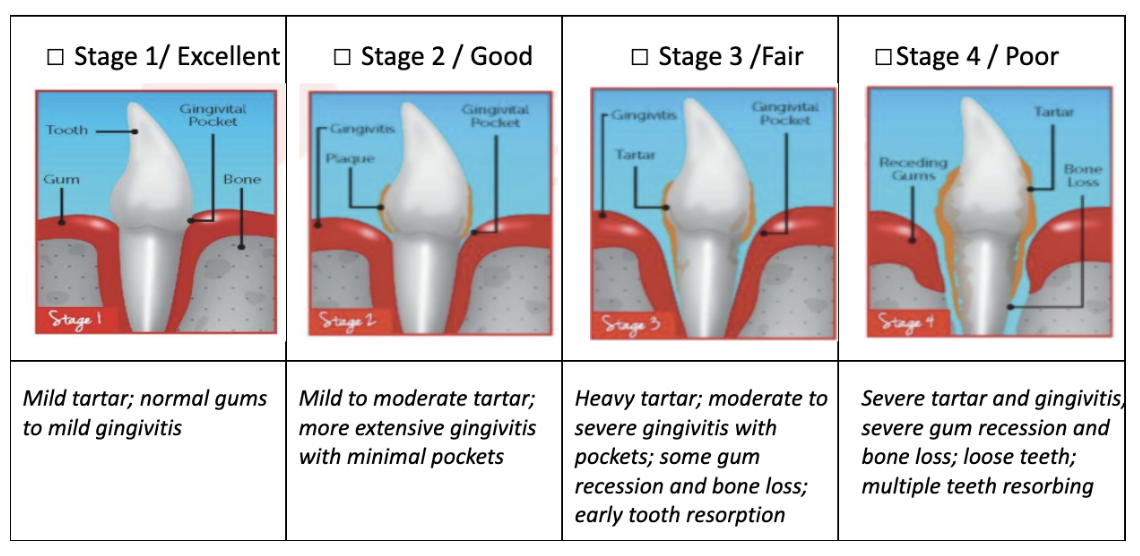
Here’s the part that surprises a lot of people: dental disease doesn’t just affect the mouth. Ongoing oral infection can impact the heart, kidneys, and liver, which is why dental issues sometimes show up as low energy, appetite changes, or subtle behavior shifts that don’t seem related to teeth at all.
Dental pain is also sneaky. Most pets keep eating, so instead vets notice things like chewing on one side, dropping food, eating more slowly, or just seeming a little “off.” Cats are especially good at hiding mouth pain.
What you can do at home
You don’t have to be a “perfect” pet parent to support your pet’s oral health. Brushing your dog’s (or cat’s) teeth a few times a week is the gold standard, but even occasional brushing helps. If brushing isn’t realistic right now, dental wipes, gels, or approved dental chews can still make a difference. Getting comfortable gently lifting your pet’s lip and taking a quick look at their gums and teeth is also helpful—you’ll notice changes sooner. Most importantly, mention oral health during vet visits, even if your pet seems fine. Small steps done consistently go a long way, and doing something is always better than doing nothing.
TL;DR
Persistent bad breath is often a sign of dental disease, not just “dog breath.”
Vets pay attention to it because it can point to pain or infection below the gumline.
Dental issues can affect more than the mouth, sometimes showing up as low energy or appetite changes.
You don’t have to do everything—small, consistent care at home + regular exams matter